


The CSA Standards classify eye and face protection into seven classes. Here are the most common in our industry: (Refer to your provincial OH&S Code for further info on the other classes).
Use the Field Level Hazard Assessment (FLHA) to determine proper PPE for a specific job task.
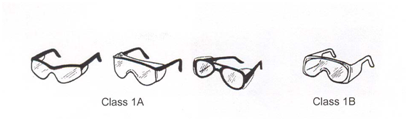
 Spectacles (safety glasses)
- Spectacles for impact protection with side protection.
- Spectacles for impact and radiation protection with side protection.
NOTE: This type of eye protection is mandatory on all Corsafety.ca sites.- Spectacles for impact protection with side protection.
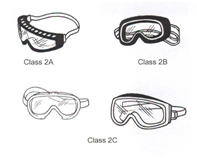
- Goggles
- Goggles for impact protection with direct ventilation.
- Goggles for impact, dust and splash protection; non-ventilated and indirectly ventilated.
- Goggles are Class 2A or 2B goggles with radiation protection.
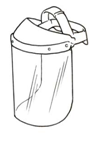
- Face shields
- Face shields offer impact and splash protection.
- Face shields offer radiation protection.
- Face shields are intended for high-heat applications.
Basic eye protection should always be worn with face shields. Face shields alone are not enough to fully protect the eyes from work hazards. When eye and face protection is required, consult the Safety department, MSDS, or safety supplier for additional information.
- Prescription Eye Protection
Even if prescription eyewear is made with "impact resistant" plastic lenses, the eyewear still does not protect the eyes like safety eyewear. Some of the differences between safety and prescription eyewear are:
- Safety eyewear must meet the impact strength requirements of the CSA Standards listed - able to withstand the impact of a 6.4 millimeter diameter steel ball travelling at 46.5 meters/second. Prescription eyewear is not subjected to such a test;
- Safety eyewear frames must be manufactured so that when struck by an object, the lenses cannot be pushed through the back of the frame into the wearer's face. Prescription eyewear may not have this feature; and
- Safety eyewear must have side protection, meet safety standard dimension requirements, and be tested as a complete protector. Prescription eyewear may not meet these requirements.